The tap that ran fine last night gives a thin trickle this morning, or nothing at all. If it's well below freezing outside, ice is probably blocking that line. Many frozen pipes haven't split yet, so the next hour counts.
Here's how to find the freeze, warm it without starting a fire, and know when to stop and call the super or a licensed plumber. All Star Restoration isn't a plumbing company. We handle the water damage side if the pipe leaks once it thaws. Prevention is covered in our New York winter pipe guide. If the home will be empty for a while, see our checklist for leaving a home in winter.
How do I know if a pipe is frozen?
The Red Cross frozen pipe page gives the first clue: if you turn on a faucet and only a trickle comes out, suspect a frozen pipe. Other signs:
- One faucet is dead while the others have normal pressure
- Only the hot side or only the cold side runs
- A toilet tank won't refill after a flush
- Frost or a slight bulge on a pipe you can see
Try every other faucet too, as the Red Cross advises, since more than one line may be frozen. If nothing in the house runs, the ice may be at the meter or where the water service comes through the foundation. It can also be trouble in the street, so ask a neighbor.
Where pipes freeze in NYC homes
NYC DEP's page on protecting pipes from freezing notes that most pipes and water meters sit in basements, crawl spaces and other unheated areas. Check these spots first:
- Kitchen sink walls. In row houses and rear extensions the sink often backs onto an outside wall, with the supply lines shut inside a cabinet against cold brick.
- Cellars and crawl spaces. Look near the front wall where the service enters, and under any extension built over open dirt.
- Garages under bedrooms. In many two-family houses a built-in garage sits below a bedroom or bathroom, and the pipes feeding upstairs cross the garage ceiling.
- Vacant units. An empty apartment with the heat turned down or a window left open can freeze lines that also serve the occupied homes around it.
Before you add heat
- Open the faucet that pipe feeds, hot and cold, and leave it open. DEP says this releases vapor from the melting ice.
- Find the main shutoff and make sure it turns. In most houses it's near the meter, where the water line enters the cellar. In an apartment the super usually controls it.
- Run a flashlight along the pipe and look for a crack or bulge. If you find one, close the valve and go to the split pipe section below.
- Set a bucket and towels under the spot and clear away stored boxes.
- Keep the floor dry wherever you'll plug something in. Utah State University Extension says to be cautious with electrical appliances in wet locations.
Safe ways to warm the pipe
Between them, DEP and the Red Cross list these tools: a hair dryer, a heat lamp, an electric heating pad wrapped around the pipe, towels soaked in hot water, or a small space heater set nearby and kept away from flammable materials.
- Begin at the faucet end, as Utah State advises, and work back toward the ice so the melt always has an open way out.
- Go slowly and keep the dryer moving, so the pipe warms gradually.
- For a pipe inside a cabinet or wall, open the cabinet doors, turn up the heat in that room and aim warm air at the wall.
- Keep going until full water pressure is back, the Red Cross test for done.
The winter safety tips on FDNY Smart, the FDNY Foundation's fire safety site, say to keep a space heater at least 3 feet from anything flammable, plug it directly into a wall outlet and never an extension cord or power strip, and never leave it unattended.
Know when to quit. The Red Cross says to call a licensed plumber if you can't find the frozen area, can't reach it, or can't thaw it.
What never to use
- Open flame. No torch, lighter or candle. DEP warns that a flame on a frozen pipe or meter is a fire hazard and can cause a steam explosion.
- Fuel-burning heaters. Kerosene heaters, propane heaters and charcoal stoves are on the Red Cross list of what not to use. NYC Emergency Management's winter weather page adds that kerosene heaters are illegal in the city.
- The stove or oven. That same city page says not to heat your home with a gas stove or oven.
- Boiling water. Utah State says not to use it, because of burns. Use hot towels.
Apartments, co-ops and condos
In an apartment, most of the plumbing isn't yours to work on. Open the faucet and the sink cabinet, and use a hair dryer on exposed pipe under your own sink. Don't open walls or touch risers and valves that serve other units. Message the super or the managing agent in writing right away.
- Rentals. NYC311's no water complaint page puts the job of keeping a building's water pipes working and unfrozen on the owner, and adds that the City doesn't provide a thawing service.
- No heat. A frozen pipe inside an apartment often means the heat is out or too low. The city's winter weather page tells tenants to speak with the owner, manager or super first and call 311 if it isn't corrected. Heat season runs October 1 through May 31, and 311's heat complaint page lists the required indoor temperatures.
- Co-ops and condos. 311 says to report the problem to the management company or board first. We explain which repairs land on the board and which on the unit owner in a separate guide.
Signs the pipe has already split
Ice can plug a split pipe so well that it stays dry until the ice melts. So stay with the pipe while it warms. Look and listen for:
- A hairline crack along the pipe, a bulge, or a fitting pushed apart
- A hiss or a drip inside the wall
- A new damp spot on the wall, the floor or the ceiling below
If you notice any of these, stop heating, close the shutoff, leave the faucet open and call the super or a plumber. DEP says a pipe that froze and broke is a repair for a licensed master plumber.
If it leaks when it thaws
- Close the main shutoff. In an apartment, get the super to shut that line.
- Unplug the dryer or heater only if you and the plug are both dry. If either is wet, do not touch it. Turn that circuit off at the breaker box only if the floor in front of the box is dry, and call for help if it is not. Con Edison's electric safety page says not to retrieve electrical products that fall in water.
- Open other faucets so the water left in the lines drains into a sink.
- Lift rugs, boxes and electronics out of the wet area, and warn the neighbor below.
- Call a plumber for the pipe. For the water, our line is 646-543-2242. Our arrival is usually 30 minutes to an hour and a half, depending on the hour and traffic.
What we do after the leak
Inside a wall, water from a split pipe runs down to the bottom plate, spreads under the flooring and shows up on the ceiling below. Our crew extracts the standing water, then traces where the rest went with a meter and thermal camera check. Those readings decide which walls get opened and which can be dried closed.
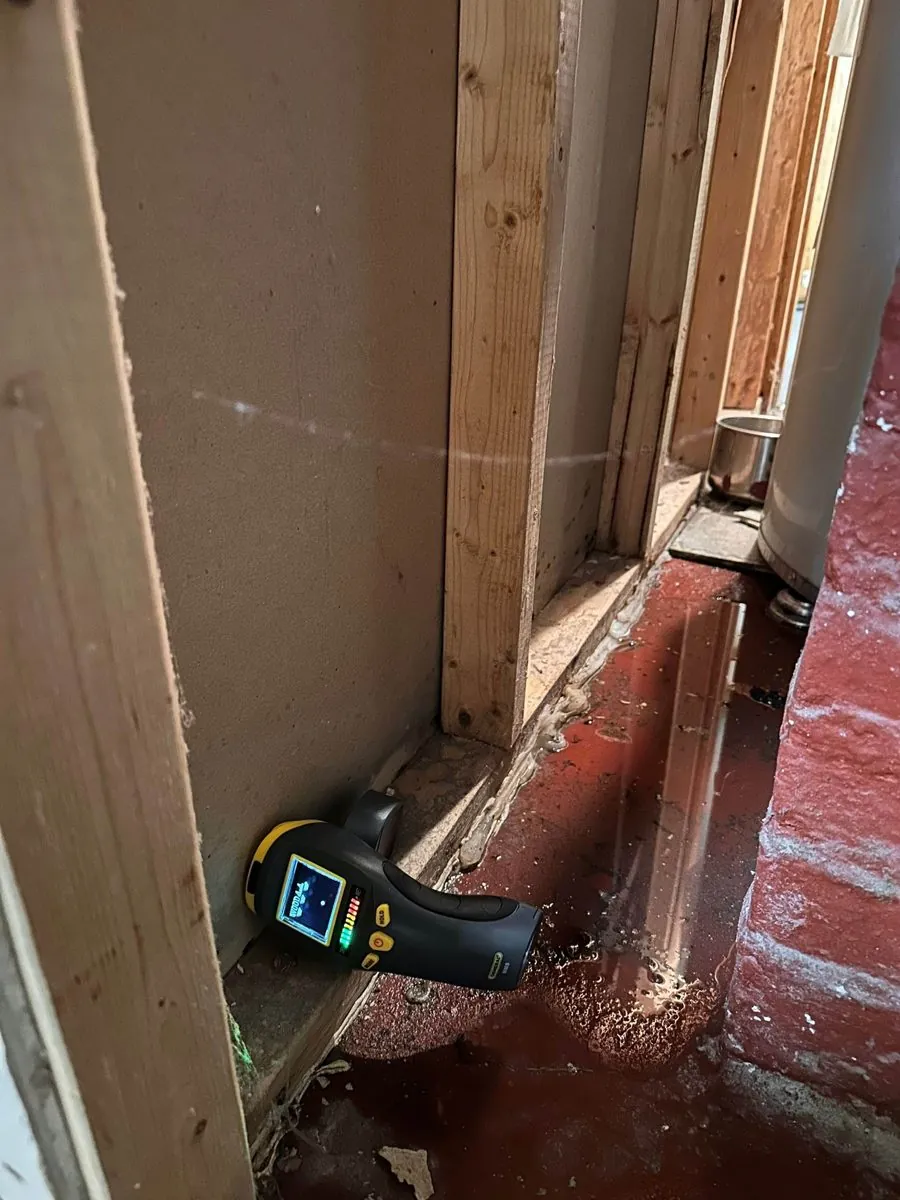
The EPA's mold guide gives wet materials 24 to 48 hours to get dry before mold is likely, a clock we explain in our 48-hour mold guide. Air movers and dehumidifiers run until the meter shows the wet spots matching a dry part of the building. Soaked insulation and sagging drywall come out, and the same crew rebuilds.
More detail is on our frozen pipe water damage service page. When water crosses into other units we arrange access with the super, as on any apartment building leak job.
The bottom line
Open the faucet, warm the pipe slowly with electric heat or hot towels, and never use a flame. If you can't reach the ice or the pipe has split, close the valve and call. Thawing is plumbing work. The water it lets go is ours.
Pipe thawed and now it's leaking
Around the clock in NYC and Nassau County, All Star extracts the water, dries the walls and floors and rebuilds.