24/7 Emergency Response  •  Serving NYC & Long Island  •  646-543-2242

Water Damage · Upper West Side

Water Damage Restoration on the Upper West Side

From the big apartment houses on West End Avenue to the row houses on the side streets, water here usually starts inside the building and works its way down through plaster and oak. Day or night, we trace it, dry the plaster and floors out, and rebuild with the landmark rules in mind.

★★★★★ 5.0 from 60+ Google reviewsIICRC-CertifiedNY State Mold License15+ Years of ExperienceLicensed & Insured

Our Part

What one crew handles after a West Side leak

When water gets into an apartment or a townhouse on the Upper West Side, one crew carries it from start to finish. We pull the standing water, trace how far it spread, dry whatever can stay, remove what can't and rebuild the rooms. The visit and estimate are free.

  • Extraction from floors and rugs, and from under oak strip floors
  • Moisture mapping with meters and a thermal camera, in your unit and the units next to it
  • Removal of soaked drywall, insulation and carpet pad, while keeping plaster that is still holding
  • Cleaning and sanitizing any wall or ceiling cavity we open
  • Air movers and dehumidifiers sized to each room
  • Rebuild of plaster, drywall, floors and paint by our own crew
  • Readings for the super, the managing agent and the co-op board when they ask

Who pays for which repair in a co-op is its own question. Our guide to splitting leak repairs between a board and a shareholder walks through the usual answers.

Block By Block

Avenue apartment houses and side-street row houses

The Landmarks Preservation Commission's 2015 release on the Riverside-West End Historic District Extension II covers the blocks between West 89th and West 108th Streets, west of Broadway. It names large apartment buildings on Riverside Drive and West End Avenue, row houses and mansions on the side streets, and a construction period running mainly from the mid-1890s to the early 1930s.

In the apartment houses

LPC puts the earlier apartment buildings at six to nine stories and the later ones at 12 to 15. Kitchens and baths in those buildings line up floor over floor, so a valve that fails high up can surface several ceilings below while the units between look fine.

We start at the wettest ceiling and meter our way up, one apartment at a time, until the readings go back to normal. That tells the super which line to shut.

In the row houses

The same release describes fronts of brownstone or brick, trimmed in terra-cotta or copper, with bay and oriel windows, dormers and balconies. Every one of those joints is a place rain can get past, and thick masonry can carry it down inside the wall before a stain appears.

So in a row house we meter the plaster on the inside of the front wall, floor by floor, and not only the spot that looks wet.

Historic Districts

Dry the inside now, permit the outside later

Many blocks here sit inside LPC historic districts. Besides the 2015 extension, there is the Upper West Side/Central Park West Historic District, designated April 24, 1990. LPC's map of that district takes in parts of the blocks from the West 60s up to West 96th Street.

Landmark status doesn't hold up the drying. LPC's emergency repairs fact sheet lists work that needs no permit, including tarps over holes in walls or roofs, temporary boards over windows and doors, and broken glass replaced in kind.

The permanent fix is different. LPC's permit types page says permanent repairs made after the temporary steps need an LPC permit. The same goes for inside work that calls for a Buildings Department permit.

On a landmarked block, that means:

  • Extraction and drying inside start on the first visit, no waiting.
  • If the water came through a window, cornice or roof, we say so on day one, so your architect, roofer or managing agent can bring in LPC while our equipment runs. If historic features had to come off, the fact sheet says to notify LPC staff right away for help applying for permanent repairs.
  • If the interior rebuild needs a Buildings permit, we plan for the LPC permit too before any wall is closed.

Checkpoints

How a West Side job moves, checkpoint by checkpoint

  • Your phone call. Our 24/7 line will ask which rooms are wet and where the water seems to start. If you can reach the valve under the sink or behind the toilet, close it. If water is coming out of a light fixture, stay out from under it and leave the switch alone. We get there usually 30 minutes to an hour and a half, depending on the hour and traffic. Give the doorman or super a heads-up so the service elevator is free.
  • Unit-by-unit walk. With you, and with the super when other apartments are involved, we meter your rooms, the unit above and the unit below.
  • Agreeing on cuts. We open a wall or ceiling only after you've looked at the readings behind it. Plaster that has let go of its lath comes down; plaster still keyed in usually stays.
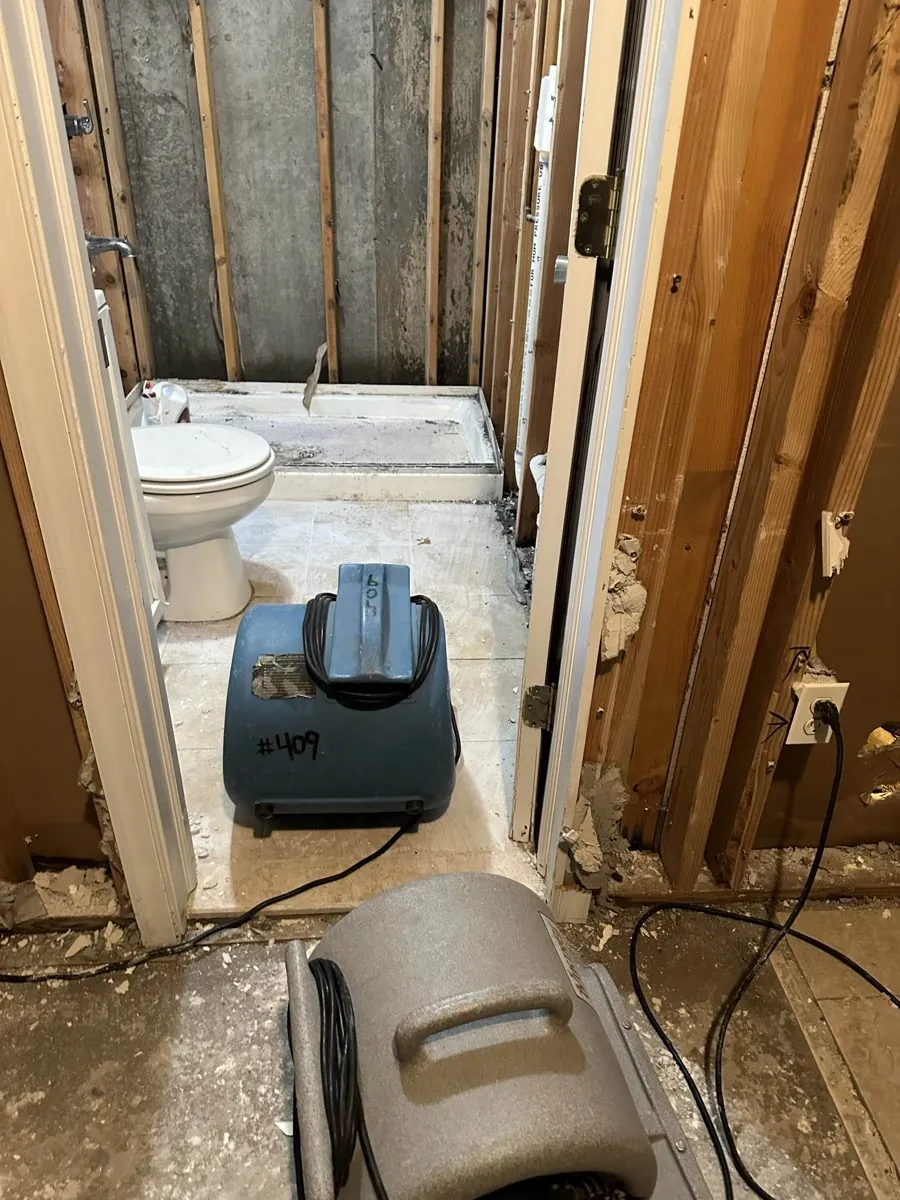
Air mover and dehumidifier drying a bathroom opened to the studs
Drying a bathroom after the wet walls came out
  • Drying watch. We come back to re-meter and move equipment where the numbers lag. Prewar apartments often have few outlets on each circuit, so we spread the load to keep breakers from tripping.
  • Dry sign-off. We compare the wet area with an untouched wall in the same apartment. When they read the same, the drying is done.
  • Plaster, floors and a final walk. Our crew handles the plaster, floor and paint repairs. If the building wants board sign-off before work resumes, we schedule around it. Then we walk the finished rooms with you.

Early Warnings

Quiet signs worth a call in a prewar unit

  • A dark ring on the oak around the foot of a steam radiator
  • Paint blistering in the ceiling corner under a neighbor's bathroom
  • Plaster going soft or chalky under a front window

A brown ring overhead is often the first thing anyone sees. Our page on stains and leaks in a ceiling explains why it pays to meter before anyone paints over it. For other parts of the borough, see our water damage service across Manhattan.

By Source

Find what failed in your building

Know what let go? Open that page. Not sure? Call and we will work it out on site.

Asked Uptown

Prewar buildings, common questions

Rain came in around a bay window on our row house in a historic district. Can the window be replaced right away?

Not the permanent replacement, in most cases. LPC lets you board or cover the opening without a permit, and we dry the wall and floor inside right away. The new window or a rebuilt frame usually needs an LPC permit first, so call LPC early and let your contractor start the application while our equipment runs.

Our living room ceiling has old plaster moldings and a medallion. Can they survive a leak?

Often, yes. Ornament that is still firmly attached usually stays and dries in place. If a run of molding has cracked loose, we take down only that piece and keep a section of it, so the profile can be matched when the ceiling is rebuilt.

The doorman found the leak while we're out of town. Can you start before we get back?

Yes, if you give permission and management lets us in. We meet the super or the front desk, extract and set up drying, and call or text you what we found and the readings after each visit. Anything beyond the emergency work waits for your go-ahead.

Whether it is a ceiling dripping on Riverside Drive or a damp spot under a brownstone window, All Star Restoration handles water damage on the Upper West Side at any hour. Ring 646-543-2242.

Your property. Our priority.

Water, fire, mold, or sewage, one call starts the recovery. We show up fast and we do not leave until it is done right.

Call 646-543-2242 Request Service

Request Service

Tell us what happened

We'll call you right back, and give you a free estimate. For an active emergency, the fastest way to reach us is by phone, day or night.

24/7 Emergency Line
646-543-2242

By submitting, you agree to be contacted by All Star Restoration by phone, text, or email about your request.

Call NowRequest Service