24/7 Emergency Response  •  Serving NYC & Long Island  •  646-543-2242

Water Damage · Cypress Hills

Water Damage Restoration in Cypress Hills, Brooklyn

Cypress Hills climbs north toward Highland Park, and many of its houses stack two or three apartments on top of each other. So water damage here usually means a leak working its way down from floor to floor, or a hard rain running downhill until it finds a basement door.

★★★★★ 5.0 from 60+ Google reviewsIICRC-CertifiedNY State Mold License15+ Years of ExperienceLicensed & Insured

Where It Starts

Two routes down the hill

Water here starts up high and stops at the lowest floor you have. Cypress Hills sits on a slope. Its northern edge runs along Highland Park, which NYC Parks describes as a "high plateau that straddles Queens and Brooklyn" (NYC Parks), and the blocks below it drop toward Atlantic Avenue.

Indoors the drop is vertical. Many homes here are small multi-family houses with two or three apartments stacked up, so a leak has floors to fall through. Here are both routes, and where we catch the water on each.

Storm Route

Outside: from the park to your basement door

A downpour runs downhill, along the sidewalk and driveway, until it finds the lowest opening on your lot.

Stop 1: the catch basin at the corner

In a cloudburst, a grate packed with fall leaves gives out first, and the overflow keeps rolling down the block. NYC DEP asks residents to "Pitch in and clear a catch basin covered in leaves, debris, or litter," and says it also responds to 311 complaints about them (NYC DEP).

The grate just uphill of your house matters most. Clear it before a storm, never while water is rushing over it.

Stop 2: under the stoop

Runoff that gets past the corner heads for a basement door tucked beneath the front stoop, or a rear stairwell with its drain full of leaves. A couple of inches pooled there and it comes in along the sill.

Stop 3: the uphill wall

This one shows up after the sky clears. On the uphill side of a house, soaked ground also pushes against the foundation, and water can seep through old mortar joints for a day or two after the rain stops.

End of the line: the basement slab

Rain that crossed a yard or driveway carries dirt and whatever was on the pavement, so we treat it as dirty water: wet carpet and the bottom of the drywall come out, and the slab gets cleaned before drying. Foundation seepage is usually a drying-only job once we confirm the water is clean.
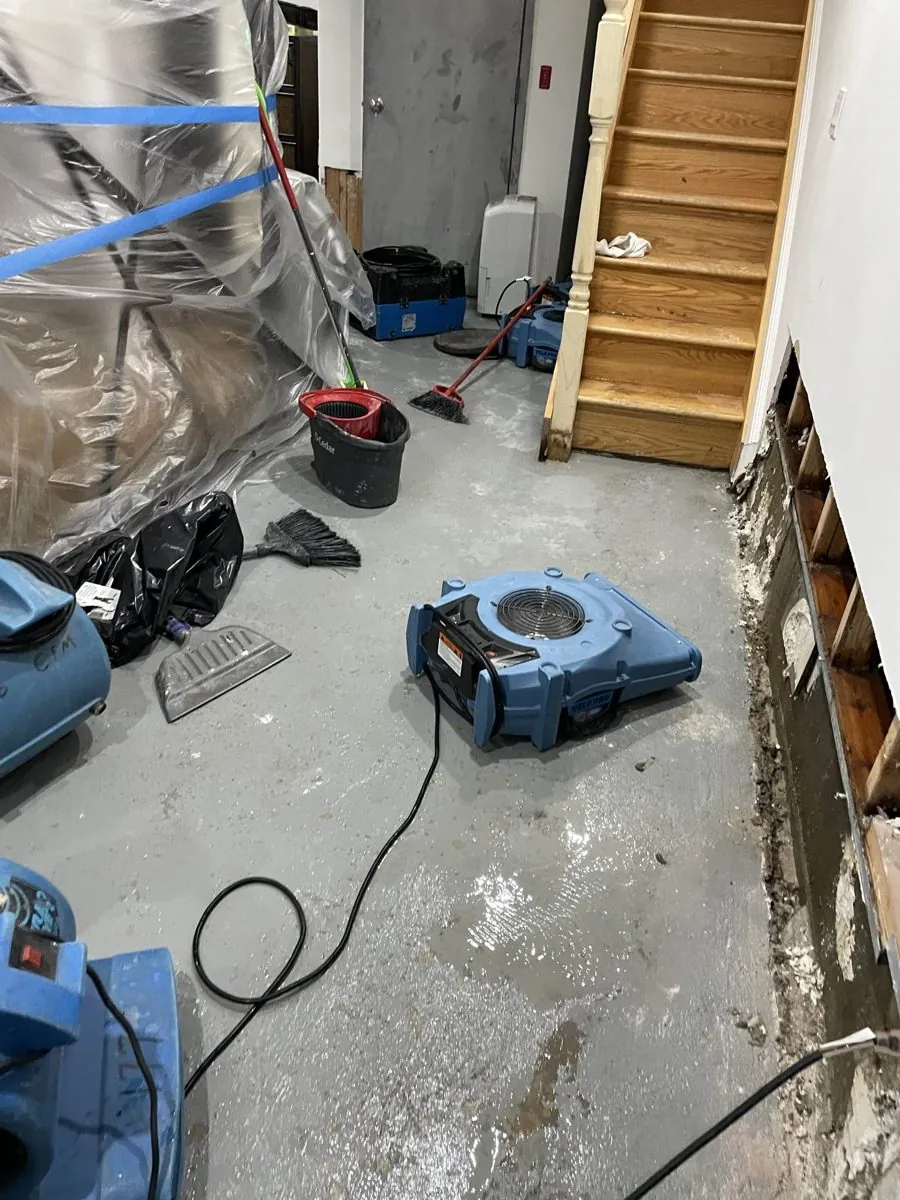
Air movers drying a basement hallway after water came in
Air movers drying a basement hallway

If the water rose out of the floor drain and smells like sewage, that's a separate job: see sewage cleanup in Cypress Hills.
Plumbing Route

Inside: from the top floor down

A leak upstairs goes straight down the plumbing line, and through every ceiling it passes.

City Planning's East New York Community Plan, which covers East New York, Cypress Hills and Ocean Hill, describes most of the area's housing as one- to three-family homes. That is why a single leak here so often runs through more than one household.

Top floor: the supply line under the sink

In frame houses with two or three apartments, kitchens and baths tend to sit right over one another, so the pipes run in one line from the top floor to the basement. When a supply line under the top-floor sink lets go, the water rides that line down.

Middle floor: wet with nothing showing

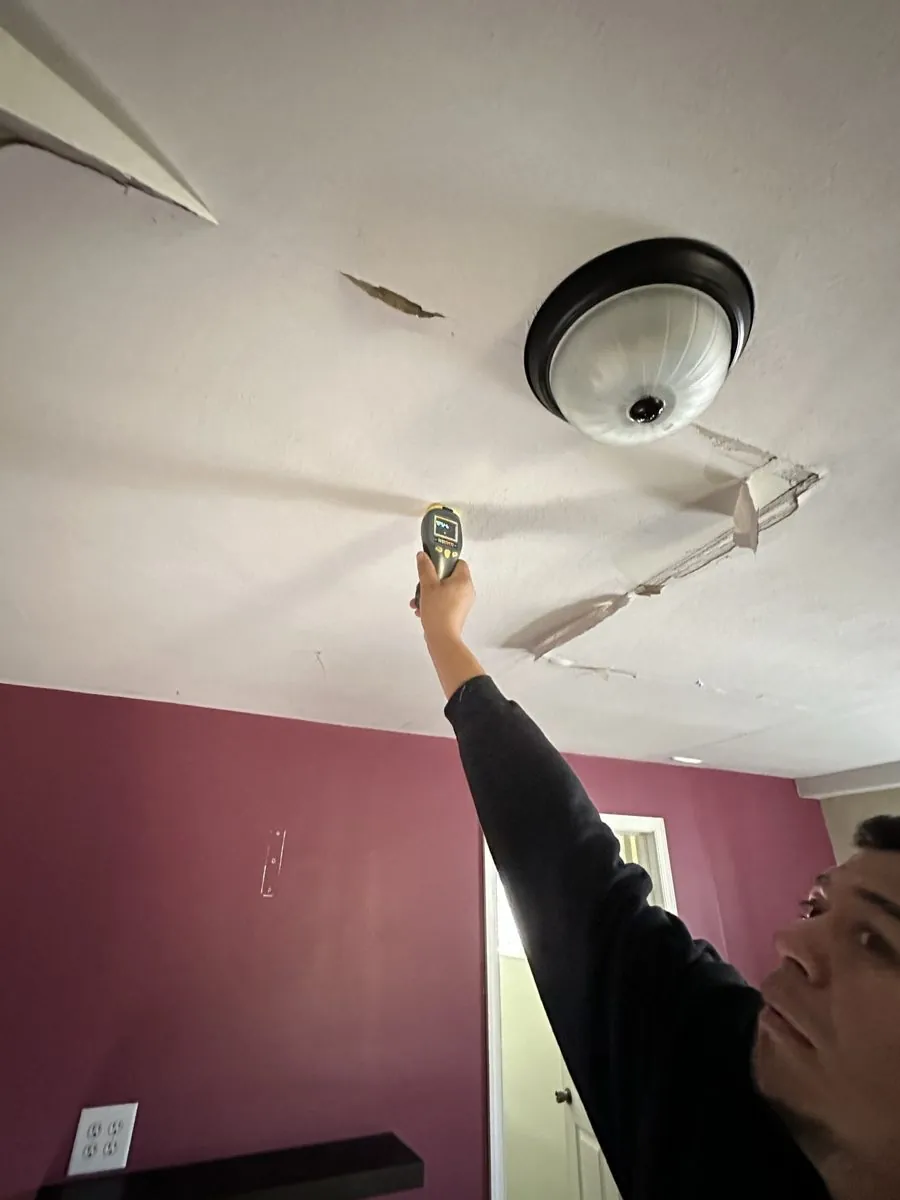
The middle apartment can stay soaked for hours with no stain, the water sitting between its floorboards and the ceiling below. We open the ceiling at the first stain, read the joists with a meter, and trace the wet path down a floor at a time. More on ceiling water damage.

Moisture meter reading a water-stained ceiling below a leak
Reading a stained ceiling with a moisture meter

First floor and basement: where somebody finally notices

By the time the first-floor family sees a drip, the water is on its third stop. The rest lands on the basement floor.

Side trip: through the shared wall

In the brick row houses, a pipe that breaks inside a shared wall can soak the neighbor's plaster before anything shows on yours. When both owners let us in, we take readings on both sides, so each insurance company sees where the water started.

Heating Season

When the boiler kicks on

Radiators and heating pipes that sat dry all summer are the first to leak. HPD's heat season runs from October 1 to May 31 (NYC HPD), and the first cold weeks are when idle radiators and boilers get tested.

If you own a two-family and live in one unit, there's no super: the boiler and every radiator in your tenant's place are yours. Typical trouble is a valve that weeps when the heat cycles on, or the boiler's relief valve dumping onto the basement floor (call a heating contractor for that one first).

Then come the January freezes. In frame houses here, split pipes tend to be in an enclosed back porch, a rear kitchen over a cold crawl space, or an empty apartment between tenants. See frozen pipe damage.

First Hour

Cut it off at the top of the route

Stop the source first, then work downhill: the floors below, then the basement.

  • Close the main. If it's plumbing, close the main valve. It's usually in the basement, beside the water meter. Turn it clockwise until it stops.
  • Warn the floors below. Knock on every door below the leak. The tenant downstairs may be at work.
  • Kill the circuit. If water is near a light or an outlet, switch that circuit off at the panel, but only from a dry spot.
  • Photograph a pipe leak. For a pipe or fixture leak, photograph and video every wet room before anything moves, the tenant's rooms too.
  • If it's rain. Pull leaves off the stairwell drain if you can reach it without standing in water, and move boxes, rugs and anything on the basement floor up high.
  • Call us. Call 646-543-2242. Dispatch picks up 24/7.

Don't wait for morning to see if it dries on its own. EPA guidance is to get wet areas and belongings dry inside a 24 to 48 hour window so mold doesn't get started (EPA).

How The Job Runs

From standing water back to finished walls

Water damage restoration in a Cypress Hills house runs in five stages, and the drying is over when the meters agree, not when the paint looks dry.

Standing water comes out first, truck-mount for a flooded basement, portable units upstairs. Then whatever can't be saved: soaked carpet and pad, swollen laminate, drywall cut above the wet line.

The framing, brick and slab that stay get cleaned and treated with antimicrobial. Then we dry, logging readings daily on every floor the water reached, with equipment spread across circuits so old breakers hold.

Most drying in these houses finishes in well under a week. What moves the price is how much has to come out, how many floors the water crossed, and whether it was clean or dirty water. The estimate is free.

Last is the rebuild: our crew puts back the drywall, floors and trim, so there's no second contractor to hire.

Questions

Asked by owners between the park and Atlantic Avenue

We're on a steep block below Highland Park. Why does our basement flood when the house next door stays dry?

Runoff takes the lowest opening it can find, and small things decide it: a door a step lower, a clogged stairwell drain, a driveway tipped toward you. We find the entry point, dry what got wet, and show you where it came in before the next storm.

My tenant upstairs says their radiator is leaking into my kitchen. Who handles what?

In a two-family you own, the heating system is yours, so a plumber or heating contractor fixes the radiator or valve. Once the leak is stopped, we dry their floor and your ceiling and document the damage for your insurance.

Can my tenants stay while the basement and the lower floors dry?

Usually yes. The equipment is loud and runs around the clock, but in most jobs each apartment keeps a working kitchen and bathroom.

Wet ceiling or flooded basement anywhere between Highland Boulevard and Atlantic Avenue, or out by the Crescent Street and Norwood Avenue stops on the J? All Star Restoration handles water damage restoration in Cypress Hills around the clock: 646-543-2242. Our Brooklyn water damage page covers the whole borough.

Your property. Our priority.

Water, fire, mold, or sewage, one call starts the recovery. We show up fast and we do not leave until it is done right.

Call 646-543-2242 Request Service

Request Service

Tell us what happened

We'll call you right back, and give you a free estimate. For an active emergency, the fastest way to reach us is by phone, day or night.

24/7 Emergency Line
646-543-2242

By submitting, you agree to be contacted by All Star Restoration by phone, text, or email about your request.

Call NowRequest Service